Category: Leadership

  • Instead Of…

    Since returning from Haiti, I’ve been oddly more introspective than normal.

    Which is, again, odd, because I’m typically pretty darn introspective.

    I’ve been analyzing the temptations and opportunities that cross my way, both subtle and bold.

    Topics I could write about…or not.

    Relationships I could develop…or not.

    Ways I could respond to people…or not.

    Things I could dwell on in my mind…or not.

    Two immediate “temptations” (if you call them that) I face regularly are to be sensational and to be trendy.

    Why?

    Sensational and trendy usually brings in attention and response.

    Attention and response makes me feel important and valued (yes, we just talked about this…)

    Sensational and trendy makes me appear “relevant” and “edgy.”

    It makes me popular.

    But sensationalism and trendiness also is an inch deep and lasts for a split second.

    It typically has no legit, long-lasting worth.

    So I’ve decided to make a list of characteristics I want to strive for – just for me – in how I want to live out this life I have.

    Sacred instead of sensational.

    Timeless instead of trendy.

    Prophetic instead of popular.

    Generous instead of entitled.

    Meek instead of aggressive.

    Quiet instead of attention-seeking.

    Humbly prayerful instead of demanding.

    Patient instead of prideful.

    Inviting instead of isolating.

    Understanding instead of judgmental.

    This list is in no way complete; rather…it’s just a sketch of traits I need to develop and cultivate in my life. These are areas where I am weak and tempted and need strength and support.

    What are some of your “instead of” statements?

  • A Candid Interview on Addiction, Confession & Transparency

    A few weeks ago, I was invited to be the guest on the Samson Society podcast with Nate Larkin & David Mullen.

    We talked about everything from cycling across the country, to life as a former preacher’s kid, to women and porn addiction (as well as drug and alcohol abuse), confession, and living a transparent life.

    Most interviews I’ve done in the past don’t dig this deep – an uncomfortable deep – but Nate and David did a fabulous job asking questions and responding with truth and grace.

    You can stream or download the interview here.

  • Guest Post by Seth Godin: Why is it So Difficult to Be Human?

    Today, these words are given by the ever generous Seth Godin.

    His guest post is titled “Why is it So Difficult to Be Human?” and it was written just for you. I think he shares a very profound question that many of us have asked on this blog before.

    He also contributed on many other blogs today, of which you can find a list here.

    ——-

    Why is it so difficult to be human?

    What does it mean to be human anyway?

    A key part of being a real person – a human being – is showing up, especially when it?s difficult, particularly when it?s frightening to do so.

    Showing up counts for a lot. Why? Because it’s scarce.

    Someone who will comfort you on the phone in the middle of the night, then throw on a bathrobe and drive to your house. That’s precious.

    Someone who tells you the truth.

    Someone who exposes herself, is present, connected and willing to let you hurt them.

    These are the things we seek out as people, and yet we rarely find them. And yet we are rarely willing to be this person.

    We built institutions, organizations and religions to make it easy to avoid being this person. The rules and principles and jobs and buildings and code words and admonitions… they all exist to protect us from the truths we’re afraid of and from the interactions we’d rather not have.

    They organize us, and organization is a wonderful way to be protected.

    We go to work and we hide. We hide behind the religion of our brand or our team or our Dunder-Mifflin employee manual. We go to a foreign country and we play tourist, because actually going there is too difficult, too risky, to exposed.

    Showing up counts for a lot.

    When we show up, we connect, we make change, we are transparent, and yes, we’re human.

    Caring hurts sometimes, and that’s inconvenient.

    The good news is that more than ever, value accrues to those that show up, those that make a difference, those that do work that matters.

    The good news is that digging deep and fighting that voice that begs us to shut up instead of show up really pays off now, in more ways than we can count.

    Faith in yourself, in your friends, in your colleagues and most of all, faith in your ability to impact our future is the best strategy I know.

    —-

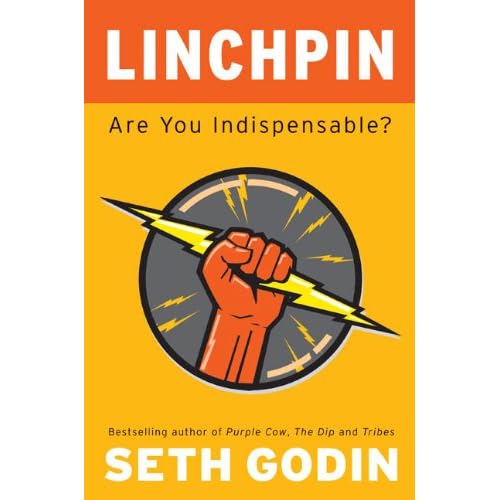
    Seth Godin’s new book LINCHPIN comes out today. It’s about art and gifts and connection and making a difference. And you should really read it because it’s really great.

    And also, you should get a few of his other books if you haven’t yet. Three of my favorites are Purple Cow, The Dip, and Tribes. All three of those have shaped my perspective and execution of how and why and when I do what I do. You won’t be disappointed!

    Disclosure of Material Connection: This is a ?sponsored post.? The company or identity who sponsored it compensated me via a cash payment, gift, or something else of value to write it. Regardless, I only recommend products or services I use personally and believe will be good for my readers. I am disclosing this in accordance with the Federal Trade Commission?s 16 CFR, Part 255: ?Guides Concerning the Use of Endorsements and Testimonials in Advertising.?


  • The Power of Words

    For most of my life, I’ve been an extremely sensitive person. I also had a terribly awkward last name growing up, so it was easy to make fun of the goofy girl with big teeth and big eyes and a funny last name.

    I spent a lot of my elementary school days crying alone in my room, brooding on whatever harsh words were spoken to me by my classmates.

    In high school, I grew out of the big teeth (I actually quite like my teeth now), and found myself in academics and sports. I was in the National Honor Society, was identified by the Duke University talented program in the seventh grade, aced my honors classes, and excelled at basketball. Our family settled into Abilene for a few years while I was in high school and I made good friends that I still adore today. I didn’t get made fun of much then, or as I blossomed into an adult and into a couple of different careers.

    My mom always prayed that I would have a sensitive heart, and now as I share it in a world where thousands can read and voice their own opinion, my skin has become soft again.

    Words move me in dramatic ways – both positive, and negative.

    The prayers and words of kindness from strangers elate me, and show me the voice of God through humanity. In more recent weeks, the critics have shown up on several posts, voicing their opinions as well.

    I am fully supportive of everyone having the right to their own thought, and the right to voicing their own thought. I don’t ever expect everyone to agree with everything I say or do, and that’s completely fine. I’ll never delete a comment that shares a different point of view, even if it’s said in an argumentative tone.

    However, I do ask you this. If you read my blog, or any others, or hear a story or meet a person and something inside you compels you to share your opinion, please consider the words you use to communicate.

    It is of utmost importance that even if we take a opposing stance on an issue, we shouldn’t debate the other person’s heart, integrity, or motivation.

    We are not, and can not be, the judge of that.

    The power our words have can be extremely positive and uplifting, and can even push someone to grow if we communicate a different opinion in a positive manner.

    Our words can also be like poison, and shrink and twist the heart and life and faith of the person with whom we disagree.

    Yes, I’m a very sensitive person and there are steps on my journey that I need to take to toughen my skin and not take harsh statements so personally and deeply.

    I also know I’m not the only person in the world that feels the power of words deeply.

    Speak gently.

    Speak carefully.

    Speak thoughtfully.

    Speak graciously.

    Speak humbly.

    We can do these things, and still disagree with someone.

    In fact, I think that may be the only way we can properly disagree with someone.

  • Forgiveness and Reconciliation

    I never thought there was much difference between reconciliation and forgiveness. In my heart, it all kind of meant the same thing – letting go of pain that someone had inflicted on me. Usually this involved some type of “making up” process involving apologies, sometimes tears, and a hug to make everything alright.

    Twelve years ago, somebody hurt me in a very painful, inexcusable way. For years, I didn’t allow myself to work through the pain as I needed to. A couple of years ago, circumstances (which were mostly out of my control) caused me to stare at this wound square in the face.

    As strange as it sounds, I’ve never doubted that I forgave this person. I feel fortunate that, for the most part, forgiveness comes easy to me. There are probably only two situations in my life where I know I still need to work on forgiving someone, but this particular hurt isn’t one of them.

    However, as I was processing through healing during this time, I began questioning if i really had forgiven this person. Sure, the scabs had been peeled off and the wounds were fresh – and it hurt…badly, all over again.

    Someone who was helping me through this sent me an email. He encouraged me and said that what I was experiencing wasn’t me being bitter or holding on (which was what I was afraid I was doing) but that I was desiring reconciliation.

    I wanted for this person to own up to the mistake and for everything – painful as it would be – to be okay again.

    And I wanted for the relationship to be harmonized and restored completely.

    Later, I read this in a book:

    Joseph was reconciled with his brothers when they came to Egypt in search of grain. By the time his brothers reached Egypt, he was able to stand before them and confront them because he had no inner feelings that would keep him from having a relationship of unity and peace with them.

    Forgiveness is unilateral. You can forgive even if [someone] never admits [their wrong doing], is never sorry, and never changes. But reconciliation requires both people’s commitment to recovery, honesty, repentance, forgiveness, and communication. Even then, reconciliation is a long and difficult process of breaking down barriers and building trust.

    You may not ever be reconciled with a person that hurt you (or that you hurt).

    That part takes both people to work through.

    Forgiveness is a necessary, but not a sufficient condition for reconciliation.

    However, forgiveness is a decision that you make, and continue to make, regardless of the other person’s choice.

    And through the cross and grace and love, you can.

  • Circumstantial Relationships

    A couple of weeks ago, I asked where people felt most alone in their lives. Was it in their finances? Marriage? Singlehood (or is it singleness?) Church? Work?

    One of the recurring themes was this notion of relationships that appear rich for a certain amount of time, but when a given circumstance changes (like somebody moves or changes their place of employment or leaves a church), the people in those once close relationships seem to fall off the face of the earth.

    My dad was the pastor of four churches, and I remember him grieving relationships that would disappear. He would try and keep in touch with old friends but because we had moved, the relationships were more difficult to invest in. I’ve also been on staff at a handful of churches – one for several years – and some of the relationships I had that I thought would be lifelong changed the moment my zip code did.

    Even now, as we’ve lived in the Nashville area for about a year and a half, we’ve moved from Nashville to Franklin, and I have gone from working full time on a church staff to writing and speaking full time, which has me traveling at least thirty weekends a year so I’m rarely actually attending the church I was on staff at. It’s been interesting to see how some of my relationships have changed when the circumstances changed.

    In most cases, it seems like when our relationships are these “circumstantial” relationships, we tend to feel abandoned to some extent when they’re gone. Sometimes we reach out and aren’t met, and sometimes nobody moves and the relationship simply fizzles out.

    And maybe those relationships weren’t meant to be a seasoned friendship.

    And maybe that’s okay.

    All this thinking on circumstantial relationships has me wondering if sometimes, we aren’t intentional enough in keeping up with people with whom we were once close. I know I’ve been guilty of investing in a relationship because I knew it was mutually beneficial to some degree, and when that changed, I pulled away. And I know that I’ve been in relationships with people who have done the same.

    I’m just as guilty as using as I am of being used. Perhaps we all are.

    What role do circumstantial relationships have in our lives? If most of us seem hurt when these relationships end, maybe they were meant to go deeper than we’ve allowed them to. Are we too busy for nurturing and cultivating relationships outside of our everyday environments?

  • All Sheep Need Grass

    The other day, I was having a conversation with a very wise woman. She is both wise in her faith and wise in her years – a mother, a grandparent, and a spiritual shepherd of many women.

    We were talking about church attendance, and people new to the faith, and people familiar and strong in the faith, and sheep and shepherds.

    I started thinking about the words I have heard so many say, “I’m not being fed,” and the defensive, reactionary responses the other many shoot back…

    “Feed yourself.”


    While yes, if we look at the metaphors, babies need milk and adults need meat.

    But the bottom line of our conversation was this:

    We all need to eat.

    And to say, “feed yourself,” well, I found myself asking if that is a statement diametrically opposed to Biblical relationships and what Galatians says about carrying each others’ burdens?

    Shouldn’t we be feeding each other?

    To keep with the metaphor, shouldn’t we be looking around us, finding the weaker sheep and taking them to a spot with more grass? More life? The stronger of us can maybe go a day or two longer or leaner but the point of it is to be aware of each other and what we need?

    Because we all need…shouldn’t we help each other find nourishment instead of getting judgmental about it?

    I realize some pastors get defensive and say that “not getting fed” means someone is just lazy…that they aren’t picking up their Bible at home or aren’t engaged in relationships.

    While there are people that certainly fit that description, there are others that are quite the opposite…the more they dig into daily spiritual discipline, the more they realize what used to feed doesn’t nourish anymore…

    When you’re hungry, sure, any kind of food will keep you alive for a while…but you can’t always eat one thing. Your diet has to be balanced and healthy.

    All sheep need grass.

    And all shepherds should care for their sheep.

    And shouldn’t all fields provide a level of sustainable nourishment?

  • What Matters Now-A Free eBook from Seth Godin

    Oh, where to begin!

    sethgodinThere are so many things I adore about?Seth Godin (and I know many of you feel the same), but?one thing I love most is his ability to collaborate and communicate in quick, memorable ways. He cuts through the junk and leaves you with a thought that will leave you thinking for days (if not?months years indefinitely).

    Seth released a free (of course!) eBook today with 72 brief (about 200 words each) and meaningful snapshots from people all over the world, including one from yours truly, asking us to share a few words on?what matters now.

    —–

    My little snippet is on page 6, and is titled?Fear. Because I think so often that fear stops us dead in our tracks.

    How do we move forward when all we hear is fear filling us up with impossibility?

    Some of my favorite contributors to this project are?Seth Godin,?Elizabeth Gilbert,?Jessica Hagy,?Jacqueline Novogratz,?Howard Mann,?Michael Hyatt,?Steven Pressfield, Megan Casey,?Merlin Mann,?Penelope Trunk,?Arianna Huffington, and?Dan Roam (and many others – these were just a handful!)

    What Matters Now is totally free, totally inspiring, and the time you spend reading through it will definitely be the best fifteen minutes of your day.

    —–

    Just click the image below to download your copy (and share it with a friend or two or forty-seven).

    What Matters Now

    And, since we’re all about free downloads today, I thought I’d also point you in the direction of two free downloads from my first book Mad Church Disease, and a free excerpt from my forthcoming book, Permission to Speak Freely.

    Happy free reading Monday! :)

    —–

  • It Means Saying Yes

    We’ve all heard the statement “When you say yes to something, you’re saying no to something else.”

    What are you saying yes to? What are you saying no to?

    This Thanksgiving, I considered myself lucky. Why? I got punched in the face with a migraine and started coming down with the cold I now have. So didn’t get a chance to stuff my face.

    You see, I have no discipline when it comes to food and social eating. None.

    Part of my training for Ride:Well is eating healthier. I’m learning the food I eat is fuel. With each bite, I need to ask myself “what’s the return on this investment?”

    I started journaling my diet for my trainer, Brandon. He analyzed it and came back with a really feasible nutrition plan. Brandon took what I was already eating and showed me where I could substitute something healthier. There really aren’t a whole lot of changes.

    Except one…

    He emailed me the plan last night so I can start keeping track of it and I noticed something was missing.

    sacrifice

    Saying “yes, I want to be healthier” means saying “no, I don’t need all my snacks.”

    Oh, don’t get me wrong. I’m still going to have the occasional brownie or mocha. But I am shifting my perspective of “I CAN’T have THIS” to “I AM HAVING this instead.”

    It’s not having a mindset of deprivation, because that will only frustrate you and stop you. It’s having a mindset of value, because then you’re understanding what something is worth.

    For me, it’s saying yes to healthier snacks so my body is fueled better.

    What is it in your life that you need to say yes to?

    *(btw, it doesn’t have to be food related…)