Category: Church

  • Book Alert: Picking Dandelions

    Anne Lamott’s Traveling Mercies and Elizabeth Gilbert’s Eat, Pray, Love became runaway best sellers in the emerging category of memoirs.? Readers were drawn like magnets to Lamott’s faith journey, set amongst her left-wing family in California and they were equally smitten with Gilbert’s personal growth as she explored Italy, India and Indonesia.

    Meet Sarah Cunningham.

    Sarah is the author of Picking Dandelions: A Search for Eden Among Life’s Weeds (Zondervan 2010).

    On one hand, Sarah is quite different than Lamott and Gilbert. She grew up in the cornfields of Michigan. Her parents were Southern Baptists. They voted Republican. She’s been married to one man, a college sweetheart, for seven years.

    In spite of those differences, there are some things in Lamott and Gilbert that you’ll find in Sarah too.

    Honesty.
    Humor.
    Quirkiness.
    Guts to explore and laugh at life’s dysfunctions.

    Sarah Cunningham’s new memoir, Picking Dandelions: A Search for Eden Among Life’s Weeds, uses some of the same approach to delve into the quirkiness and humor on the other side of the religious and political spectrum.

    Take how Sarah journaled her prideful thoughts for a week straight…something she reports backfired because people don’t make 4,000 page journals. Or the heart to heart talk she has with God in which she cites Drew Barrymore’s career while praying (as if God is impressed by an occasional pop culture reference, she says). Or her story that ends with this line: “Jesus wouldn’t charge people to pee.”

    In the end, Sarah’s loose collection of stories accomplishes something insightful too. A subtle theme hangs in the background suggesting that humans, especially those on a quest for God, cannot afford the luxury of unchanged living.

    It’s sort of refreshing that Sarah, raised in the right wing, can weave elements of faith into a spiritual memoir too because it suggests that there are valid, messy spiritual discoveries for all of us, no matter what corner of the earth or political landscape we grow up on.

    Intrigued? Learn more about Picking Dandelions: A Search for Eden Among Life’s Weeds.

    What’s a memoir that’s impacted you?

    Disclosure of Material Connection: This is a ?sponsored post.? The company or identity who sponsored it compensated me via a cash payment, gift, or something else of value to write it. Regardless, I only recommend products or services I use personally and believe will be good for my readers. I am disclosing this in accordance with the Federal Trade Commission?s 16 CFR, Part 255: ?Guides Concerning the Use of Endorsements and Testimonials in Advertising.?
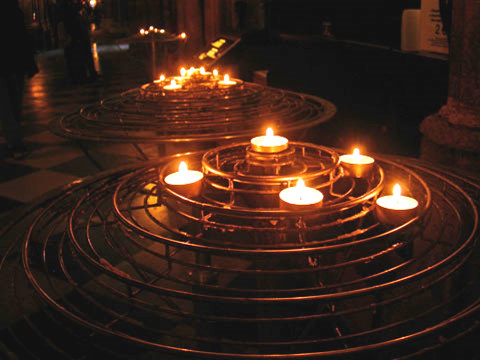

  • How Can I Pray for You?

    Sometimes, when my writer’s brain is empty and there aren’t blog posts streaming from my fingers, I take that as a sign that I need to shut up a little bit and reflect and refill.

    As I take some time to do that over the next few days, how can I pray for – or celebrate – with you?

    Feel free to leave your requests in the comments section or pass this along to a friend you know who might need some encouragement and prayer from others.

    Let’s have this weekend be a little more intentional – a little more focused – on carrying each others’ burdens and celebrating with each other as well instead of just another weekend of blogging and talking.


  • Inclement Weather and Church Closings

    I don’t get it.

    Maybe it is the fact I spent 23 of my almost 30 years of life in Texas (and most of that in West Texas, where we spent Christmas in shorts chasing the tumbleweeds outside. Hey, we were poor. That’s how we had fun. Okay?) but even after working in several churches over the last six years, I still do not understand why churches would have services during inclement weather.

    I’m not a very logical person. I really am not. But something logical inside me asks,

    “Why would you have people driving to church when there’s an 18 car pile up on the interstate because of the ice?”

    Why not provide resources for families or neighborhoods or community groups to “have church” without having to really travel in the weather? Use the internet to distribute material prepared ahead of time.

    Something.

    Anything.

    Since many of you work or serve in churches, and by reading my Twitter stream today I can see most churches are choosing to stay open regardless of how inclement the weather…may I be so bold to simply ask…

    Why?

    I really don’t understand and this is not a criticism at all…Please help me not feel like such a heathen for wanting to keep people off the roads when the weather outside is frightful.

  • Value vs. Usefulness

    Lately, I’ve been immersing myself in the words of Thomas Merton. If you’re not familiar with his writing, he’s a 20th century Trappist monk and writer (more here) and his words have the power to transcend the logical and explore the spiritual undercurrents in which we rarely dare to wade.

    I read this from Merton other day, and it reminded me of something I wrote in Mad Church Disease.

    “We are so obsessed with doing that we have no time and no imagination left for being. As a result, men are valued not for what they are but for what they do or what they have – for their usefulness”

    In Mad Church Disease, I confessed I was so busy “doing” things for God that I had forgotten how to simply “be.” with him.

    I love what Merton adds though – this second part:

    “As a result, men are valued not for what they are but for what they do or what they have – for their usefulness”

    Essentially, when we become wrapped up in our productivity, ambition, and success, we will inevitably cast the same expectations on others. We will focus on what they do instead of the beautiful layers of who they are, removing us further from God’s design to exist in a non-judgmental, merciful community where we consider others better than ourselves…

    I know I constantly am driven by my ambition and the results of it. And as a culture, upon meeting someone new, we typically ask, “So…what do you do?” While that’s an innocent question in and of itself, I think it’s an indicator of the priorities we’ve subtly placed on what it means to be a valuable human being.

    What do you think? Have you experienced this in your life?


  • Circumstantial Relationships

    A couple of weeks ago, I asked where people felt most alone in their lives. Was it in their finances? Marriage? Singlehood (or is it singleness?) Church? Work?

    One of the recurring themes was this notion of relationships that appear rich for a certain amount of time, but when a given circumstance changes (like somebody moves or changes their place of employment or leaves a church), the people in those once close relationships seem to fall off the face of the earth.

    My dad was the pastor of four churches, and I remember him grieving relationships that would disappear. He would try and keep in touch with old friends but because we had moved, the relationships were more difficult to invest in. I’ve also been on staff at a handful of churches – one for several years – and some of the relationships I had that I thought would be lifelong changed the moment my zip code did.

    Even now, as we’ve lived in the Nashville area for about a year and a half, we’ve moved from Nashville to Franklin, and I have gone from working full time on a church staff to writing and speaking full time, which has me traveling at least thirty weekends a year so I’m rarely actually attending the church I was on staff at. It’s been interesting to see how some of my relationships have changed when the circumstances changed.

    In most cases, it seems like when our relationships are these “circumstantial” relationships, we tend to feel abandoned to some extent when they’re gone. Sometimes we reach out and aren’t met, and sometimes nobody moves and the relationship simply fizzles out.

    And maybe those relationships weren’t meant to be a seasoned friendship.

    And maybe that’s okay.

    All this thinking on circumstantial relationships has me wondering if sometimes, we aren’t intentional enough in keeping up with people with whom we were once close. I know I’ve been guilty of investing in a relationship because I knew it was mutually beneficial to some degree, and when that changed, I pulled away. And I know that I’ve been in relationships with people who have done the same.

    I’m just as guilty as using as I am of being used. Perhaps we all are.

    What role do circumstantial relationships have in our lives? If most of us seem hurt when these relationships end, maybe they were meant to go deeper than we’ve allowed them to. Are we too busy for nurturing and cultivating relationships outside of our everyday environments?

  • Breaking News: New Survey

    (*On a quick note, I changed hosts for my blog over the weekend and if you encounter any problems, I’m so sorry. They are being worked on!)

    I just finished reading a survey and as I write this, am literally boiling with a combination of red-hot anger and red-hot despair.

    The Bliss Institute recently commissioned a study on what “Conservative Religious Activists” deem important and what “Progressive Activists” deem important. You can download the entire study here, but for definition’s sake:

    “Conservative and progressive religious activists have distinct profiles in terms of affiliation, practice, and belief”

    “Conservative religious activists are almost exclusively Christian.”

    “Progressive activists are markedly more diverse in terms of religious affiliation. No single faith tradition makes up a majority of progressive religious activists.”

    I’ll let the chart do it’s work, but let’s just say that only 23% of us “Christians” (the survey defined it even further as a majority of Christians being mainline protestant, um, people like you and me) think that poverty is an issue we should stand behind and fight.

    The red in the survey represents a majority of “Christian” folk.

    The blue is just your average, ordinary Joe.

    Jesus himself said something about how people will know we are followers of Christ. (John 13:35)

    According to this survey people will know we follow Christ by how much we fight gay marriage and not poverty and disease.

    We care so much about abortion, about children before they are born. And there’s absolutely nothing wrong with that.

    However, I’m wondering if the phrase “Sanctity of Life” in our political language should be changed to “Sanctity of the American Unborn” because according to these statistics, there are quite a few people who don’t care what happens to the child (or the parents or the siblings) once that baby is actually born.

    If they these people really did care, well, actions speak louder than words…

    …What about the 30,000 children who starve to death every day because of hunger?

    Or the millions who die from malaria each year?

    Or the millions who die from diarrhea because they have no clean water.

    This is horrific.

    This must change.

    We must begin to engage this “Christian” world view that poverty is not an issue and help them see that caring for the poor is at the very heart of Christ.

    I don’t know what that looks like yet, but we’ve got to start somewhere.

  • All Sheep Need Grass

    The other day, I was having a conversation with a very wise woman. She is both wise in her faith and wise in her years – a mother, a grandparent, and a spiritual shepherd of many women.

    We were talking about church attendance, and people new to the faith, and people familiar and strong in the faith, and sheep and shepherds.

    I started thinking about the words I have heard so many say, “I’m not being fed,” and the defensive, reactionary responses the other many shoot back…

    “Feed yourself.”


    While yes, if we look at the metaphors, babies need milk and adults need meat.

    But the bottom line of our conversation was this:

    We all need to eat.

    And to say, “feed yourself,” well, I found myself asking if that is a statement diametrically opposed to Biblical relationships and what Galatians says about carrying each others’ burdens?

    Shouldn’t we be feeding each other?

    To keep with the metaphor, shouldn’t we be looking around us, finding the weaker sheep and taking them to a spot with more grass? More life? The stronger of us can maybe go a day or two longer or leaner but the point of it is to be aware of each other and what we need?

    Because we all need…shouldn’t we help each other find nourishment instead of getting judgmental about it?

    I realize some pastors get defensive and say that “not getting fed” means someone is just lazy…that they aren’t picking up their Bible at home or aren’t engaged in relationships.

    While there are people that certainly fit that description, there are others that are quite the opposite…the more they dig into daily spiritual discipline, the more they realize what used to feed doesn’t nourish anymore…

    When you’re hungry, sure, any kind of food will keep you alive for a while…but you can’t always eat one thing. Your diet has to be balanced and healthy.

    All sheep need grass.

    And all shepherds should care for their sheep.

    And shouldn’t all fields provide a level of sustainable nourishment?

  • BOOK GIVEAWAY: Introvert or Extrovert?

    Every few years, I’ve taken the Meyer’s Brigg personality test. My standard result has been an INFJ (Introverted, iNtuitive, Feeling, Judging) which essentially means I find energy in solitude, think with my “gut” rather than facts, make decisions based on feelings instead of logic, and process information and events in an organized manner. If you really want to get a good feel for my personality, read this. It pretty much nails it.

    When you take the test, you get a number indicating how much you show those characteristics. For instance, I’ve tested as on the line for an introvert/extrovert, but am almost as high as one can go with iNtuitive and Feeling, and then I’m also “low” on the judging side — I can be disorganized when I’m stressed.

    Something I’ve learned over the last year is if you don’t know who you truly are, you can’t let a test tell you.

    Since the test has said, “you’re an introvert,” I believed it. But then I started getting really confused.

    After speaking engagements and interacting with people, I would be so amped up sometimes I couldn’t sleep. That’s not a characteristic of an introvert. I thought back to the week I spent alone in the San Juan islands and how, when I came back, I pretty much cried the whole time – not because I was sad about leaving, but because I was so depleted.

    I was having breakfast with a very wise friend the other day and she said, “Maybe you’re not an introvert. Maybe you’re an insecure extrovert and you use your need to be alone when you’re faced with a situation where you aren’t confident or sure of yourself.”

    Oh, snap.

    For me, I think she was dead on. I thought of a few different social events that I’ve declined because I knew there were these perceived “better than me” people in attendance.? Like faking sick, I called in “introverted” and said I was just trying to be healthy.

    Now, that’s just my story. By all means, if I am an extrovert it’s barely there…so, if anything, I am probably riding the line.

    My friend Adam McHugh recently released a book called Introverts in the Church, which I had the privlege to endorse. My thoughts on the book:

    “For the longest time, I’ve considered my wiring as an introvert a thorn in my side. After spending time engaging with others, I felt so empty and overwhelmed . . . and lonely. With my calling as an author and pastor requiring me to publicly speak and consult, I wondered if I misunderstood my place in this world. In Introverts in the Church, Adam brings a voice to those of us who often trade ours in for a little bit of respite. This is not only a needed resource for introverts; all leaders need to read Introverts in the Church for a better understanding of how introverts can lead, how they follow and how they refresh.”

    Adam has given us 10 copies of Introverts in the Church to giveaway. He’ll pick 10 random winners next Wednesday.

    All you have to do to enter is leave a comment and tell me if you’re introverted, extroverted, and how you think that affects your relationships in the church. Statistically speaking, introverts are a minority. Does it feel that way to you?

  • Going Way Back: Celebrating Big Givers

    I’m wrapping up my manuscript for Permission to Speak Freely this week, so I’ve decided to repost previous blog material from the archives. I went and found some that had great conversation in the comments, and since there are so many new readers, figure it would probably be new to you and we can delve into the dialogue again.

    This one was posted about 18 months ago…back in the day when I didn’t use capitalization properly. Sorry about that.

    Read and discuss…What do you think? I’d especially love to hear from churches who do this kind of thing, because I still have a very difficult time wrapping my mind around how this is even Biblical, to be completely honest with you.

    —–

    Celebrating Big Givers

    sometimes churches have special events to celebrate their top givers. most of the churches i know do this for members who give over a certain amount of money per week/month/year. usually there is an appreciation dinner or vision casting event. and the people who don’t “give big” don’t even hear about these events. i was on staff at a church once and was in charge of making sure the invites were sent out. i was talking to someone that worked on facilities to see if he’d be setting up the venue and he didn’t even know about it. his family didn’t give enough to be invited, and the event was pretty much on a need-to-know basis.

    so, i?ve always wondered why this is. don?t get me wrong?i realize those who give significant amounts of money to the church typically do it consistently and that saying goes ?20 percent of the people give 80 percent of the income? and i do think giving (in general) should be celebrated and talked about.

    here is where i get hug up – equal giving does not mean equal sacrifice.

    someone who making six figures a year can easily drop $500 a month in tithing but for someone else to give $500 a month could be extremely sacrificial.

    why aren?t those things equally celebrated?

    why do people even track what other people give? what about the people who give in cash? or the people who have been financially devastated somehow…shouldn’t they be helped by the church, or have a dinner thrown for them?

    does your church celebrate the ?big givers?? do you celebrate all the givers? do you celebrate giving at all? what do you think?