I met Jud through my friend Mike Foster. The two of those guys authored a great book called Deadly Viper Character Assassins and every once in a while, I pop over and contribute on the Deadly Viper blog.
Jud and I met face to face for the first time at Catalyst, although he had helped me process some significant changes in my life before then.
He’s also part Texan. Which I dig.
Jud had a book release a few weeks ago called Eyes Wide Open: See and Live the Real You. I haven’t finished it yet, but that doesn’t stop me from recommending it to you.
Why?
I have always had a HUGE problem accepting WHO I am…the person God has created me to be. It’s been difficult to embrace the quirky, awkward, not always put together, sometimes shy girl who gets sweaty feet when she’s nervous. And as such, I would always try super hard to prove myself.
To God. And to others.
I am definitely on a journey to find my identity in Christ. And that is what this book is about.
And since we’re back to giving books away on Thursdays, I have ten copies of Jud’s book to giveaway.
All you have to do is leave a comment talking about your own journey to finding your identity or embracing who you are. I’ll pick 10 comments at random and contact the winners by email next Thursday.
If you can’t wait that long, pick up a copy of Jud’s book here.
I told you guys, I’m going to be giving a bunch of books away, no strings attached!
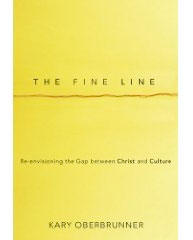
Because we?re humans, we?re hard-wired toward irrelevance?toward crossing the line. Jesus wanted his followers to be different. In the garden of Gethsemane, hours before facing the cross, he prayed that his followers would be in the world, but not of it.
So where is this line?
Separatists cross it by going out of the world.
Conformists cross it by becoming of the world.
Only Transformists walk The Fine Line of being in the world, but not of it.
So which are you?
I tend to lean toward the conformist camp. I grew up very traditional, so now I am freely exploring the beauty and diversity of my faith.
Take this little test to see which camp you naturally gravitate toward.
*The Separatists?are anti-everybody, anti-everything, and they retreat from culture. Their excessive rules are an attempt to escape the world. Those who lean toward the Separatist camp are guilty of certain characteristics. Three of the most common are that they allow:
rules to replace relationships
microscopes to replace mirrors
performance to replace passion.
*The Conformists?are hypocrites, biblically shallow and consumers of culture. Their excessive desire for trendiness results in merely mimicking culture. Those who lean toward the Conformist camp are guilty of certain characteristics. Three of the most common are that they allow:
media to replace meditation
liberty to replace love
tolerance to replace truth.
Thankfully there is an alternative.
Enter stage right the Transformists, a new breed of Christ followers who are in the world but not of it and more clearly mirror New Testament Christianity. The backstory of Transformists is quite convincing. For starters, they don?t need to have everything figured out, for that would mean they?re Separatists. They don?t need to say anything goes, for that would mean they?re Conformists. They neither add to God?s Word nor do ignore it. Instead, they obey it.
They?re not perfect, but they?re seekers. They long to have a pure relationship with the Creator of the Universe. They desire to know the ?why? behind the ?what? and the purpose behind the principle. Of course there will be mistakes along the way, but this is what sets them apart. They have a little more grace and patience with each other, because they know what they?ve been saved from.
Above all else, they passionately love God and people. They don?t fear culture because they?re called to shape it. They don?t fear Christianity because they?re called to embody it. They are the Relevant. They are the Transformists*
HOW TO WIN THE BOOK:
**By owning up to your junk and posting a comment about which camp you lean toward, you?ll be entered to win The Fine Line give-away.**
10 random winners will score a copy of Kary Oberbrunner?s new Zondervan book The Fine Line and discover more about the Transformist way and narrowing the gap between Christ and Culture.
So, about this time last year, I was on staff at LifeChurch.tv in OKC. One afternoon, I remember sitting with Terry Storch, Bobby Gruenewald, Craig Groeschel and Lance Young in Bobby’s office (it was pretty cramped…somehow Craig ended up sitting on the floor wedged behind where the door would open) and on this HUGE whiteboard, we were dreaming up this idea of uniting churches all over the world.
Could churches actually combine efforts to share resources, teaching videos, to give financially, and to fast and serve and pray together? What would that look like?
Why not try? And the whiteboard got really full, really quickly.
One Prayer was born. It started with four churches, then grew to eight. Then double digits. Then hundreds. Then thousands. And before you knew it over 2 million believers across the world were participating in this movement.
One of the coolest parts for me was watching the videos that churches would share for other churches. Because it’s all about sharing. Last year, people taught on what their “One Prayer” for the church would be. Personally, some of my favorite videos were from pastors who had no fancy equipment. Those who put their handicam on a tripod and sat in front of a wall and delivered an incredible challenge.
It’s almost time for One Prayer 2009, and just in case you haven’t heard about it, check out this video from Craig.
I’d really encourage you to explore the option of your church participating in One Prayer 2009. Whether you can contribute a video or not, just participating in such an amazing experience will be life changing for you and your church. The theme this year is “God is _________.” You can get the details and register here. Oh yeah. Totally free. Of course.
(By the way, Craig, if you stumble on this post. I think your hair looks awesome in this video!)
Each person has a unique point of view on faith and Christianity, and needless to say, our conversations varied greatly.
I’m definitely in a season where I’m exploring and discovering what faith is to me – instead of just leaning into the tradition of my upbringing (which, don’t get me wrong, plays an important role).
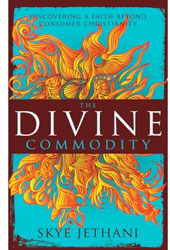
A book that has helped me define so much of the tension between culture and faith is The Divine Commodity by the aforementioned Jethani.? Skye is a Zondervan author and we work with the same team, so Genius Marketing Guy sent me a copy of Skye’s book a long, long time ago – thinking I’d find it interesting.
I have to admit. I get around five books in the mail each week (not that I’m complaining), but it’s hard for me to find time to read them all. It did take me a few months to get to Skye’s book.
I wish I would have read it sooner.
As soon as I finished, I passed my heavily highlighted and marked up copy to my friend Shaun, who devoured it and gave a few other copies I had to a couple of friends on staff.
If you’ve ever felt a tension between faith, culture, and consumerism, I can’t recommend this book enough.
Skye doesn’t approach the topic critically, which one could easily do. He simply explores how a timeless faith and an ever-changing consumeristic culture mix (or in some cases, how they don’t mix).
Since may of the pastors I know would easily dismiss this book (because hey, let’s just admit that many of us wrestle consumerism in every compartment of life and it’s easy to just let it exist in apathy), I asked Skye about how church leaders should approach this book.
And I also asked to give away ten copies to random commenters.
Below is my conversation with Skye, as well as a quick video we shot at the CT Offices on Tuesday. I realize it’s a little lengthy, but it’s completely worthwhile. Get the book. It’s beautiful. It’s thought provoking. It’s incredibly well written.
Anne: For those of us who have read The Divine Commodity, we know you?re not being divisive or writing about ?what?s wrong? with the church.? We know that it?s a book that explores the culture of modern-day faith and Biblical context and wisdom.
Why should a pastor read this book?? How can those of us who aren?t pastors graciously help communicate the message of The Divine Commodity without coming off like we have an agenda?
Skye: When the Apostle Paul wrote his letters to the churches, his great desire was for them to all reach full maturity in Christ Jesus. This required more than merely forming them into people of love and faith. Paul also diagnosed the ways they had been malformed by false teachers, ungodly cultural mores, empty philosophies, and the deceitfulness of the flesh. Making disciples was not just a process of construction, but also deconstruction. To the Colossians, Paul wrote about ?taking off? certain things, and ?putting on? others.
This is why I wrote The Divine Commodity, and why I believe church leaders as well as anyone serious about discipleship should engage the book. North American culture is dominated by consumerism?and I don?t simply mean the behavior of consumption, but the worldview of consumerism. The book does not take issue with the buying and selling of products, but the extension of self-indulgent and self-centered consumption to the point that it becomes the lens through which we see all of life and the cosmos?including God.
If pastors are passionate about ?going and making disciples,? then they don?t only need to know what to form people into, but also what they must be formed out of?just as a doctor cannot prescribe a remedy until she has diagnosed the disease. The Divine Commodity explores what consumerism is, and how it shapes our understanding of faith, worship, mission, church, discipleship, and even God. Once this malformation is diagnosed, the book prescribes practices (both individual and corporate) that help us ?take off? these things and ?put on? Christ. It is first and foremost a book about discipleship within a consumer culture, and this is why pastors ought to read it?it will help them understand the context in which they are called to make disciples with its unique challenges and opportunities.
Now, to address your second question about how those who are not pastors might graciously communicate the book?s message. That?s a much simpler answer?live it. The book does not advocate a radical coup within the church or call for a revolution in the church?s structure. It?s not about strategy, systems, or programs. In fact, if nothing ever changes about the way your church operates, you are still able to engage and employ the lessons within The Divine Commodity. I don?t believe we can (or should) overturn our consumer culture. Nor do I believe churches (from the mini to the mega) should radically revamp their structures. That wouldn?t solve the threat posed by consumerism?it?s a far more elusive foe because the battlefield between consumerism and the Kingdom of God is not external, but within the heart and imagination of every believer.
As consumerism?s grip over you begins to loosen, and you experience the transforming reality of ?Christ in you, the hope of glory,? the way you worship, serve, and relate will begin to change. In time, through resources like The Divine Commodity and others, perhaps others will join you in your quest for a richer Christian life. The gospel has always been an incarnate reality, transmitted life to life across the medium of relationship. As this begins to take root within your church, regardless of what the leadership or programming is doing, the message of hope, liberty, and fullness in Christ will spread like yeast through a lump of dough. So, rather than criticizing those still enraptured with Consumer Christianity, save your energy and simply let your life reveal a fuller glory which does not fade.
(Also, next Thursday I’ll be giving away 10 copies of another book….stay tuned! This might turn into a habit…)
To win the book, please leave a comment telling me how you’ve wrestled with a consumerist culture and faith, and I’ll randomly pick 10 people over the weekend and send them a copy of Skye’s book.
Charlotte Avenue was bumper to bumper traffic as one would expect at 6 pm on a weekday. Why I chose this route instead of taking the highway is beyond me.
As I inched up closely to the next stop light, I glanced up to read your old fashioned marquee sign with the archaic plastic letters, aged and tired.
I rolled my eyes at your corny Christian saying.
After what seemed like an eternity, the light turned green and I finished my excursion to The Mecca of Things Unnecessary: Target.
Picking up my prescription (and contributing an additional donation of $64 to The Mecca), I traveled home, back on Charlotte Avenue once again.
Back to you again.
But instead of rolling my eyes again, I flashed back to my formative elementary school years when I’d pull down the boxes containing the same plastic letters in my dad’s workroom in the church where he was a pastor. He’d leave me a quote with a saying for the sign not so different than the one I’d read on yours today. Cautiously, I’d climb the church’s four foot ladder and meticulously line up the letters on the sign to form the words just right.
Because I was just as compulsive then as I am now.
I imagine your pastor similar to my father in those days.
Balding.
The only person “on staff.”
Away from his family.
Putting those little golf scoring pencils in the pews while picking up last week’s bulletins that people had left stuck behind the hymnals.
His office is a mess of old Matthew Henry Commentaries and prayer requests and he sits back in an old office chair with cracks in the leather, and as he looks at a photograph of a picture of his family, he leans back and takes a deep breath.
And I’m really sorry for rolling my eyes at your sign earlier.
It was immature and inconsiderate. Because your boldness to say something positive on a street that sees so much darkness is nothing short of noble and redemptive.
And to your pastor I say thank you for being the man you know you’re supposed to be. It’s not an easy or popular job, and definitely not one that’s financially rewarding, but my own back yard is a better place for having you love and give the way you give.
At the National Pastors Convention, I had the chance to sit onapanel and discuss the use of technology and social media within the church. You can actually see our pixel-shaped heads here if you’d like to see what went down (Thanks, DJ).
Anyway, over the last couple of months, the brain contained in my own pixel-shaped head has been doing a LOT of thinking. A lot. And if you were to have seen the interview I did at the I3 Conference, you’d see that I literally contradict myself within a week’s time.? Cynthia asked if I believed in the phenomenon of Online Community to which I eagerly argued, “yes, yes, a million times yes!”
At the NPC panel just a few days later, when I met Skye Jethani (remember, whose book Divine Commodity is the most profound thing I’ve read in a long, long time), we continued this “online community” conversation on the panel.
Here is an excerpt…I’d love for you to post your thoughts over on Out of Ur, so I’m closing comments here.
In some instances, these online conversations have translated into personal communication (by email, chats, or phone) and some have even turned into face-to-face meetings. The platforms of social media certainly give these personal interactions a “jump start” so to speak, because you do, in some regard, know bits and pieces of the other person’s life.
But this is where it gets muddy for me. Is it community?
Given my experience living in both worlds, it may be surprising to hear, but I am beginning to lean on the side of no?what happens online is not community. Before you send me an army of frowning emoticons, please hear me out:
I believe what happens online is connection…not community.
People can be vulnerable and honest online. And at times these online connections can be more life-giving than many of our offline relationships, but they are not the same.
You will read an announcement in the full post on Out of Ur that might surprise you.?= Once you’re done over there, come back over here and you’ll get the full scoop.
See you over there!
Then back here.
Phew! I’m getting tired with all this running around.
If you didn’t already know, I am a major, major fan of the people at Healing Place Church.? I had the opportunity to hang with some of their staff and volunteers back in December.? Serving the homeless and then going on the Midnight Outreach was one of the most profound experiences of my life.? It’s been two months and I am still processing it.
When I came back to Cross Point after my trip to Baton Rouge, I couldn’t shut up about how HPC is just oozing the love of Christ in simple acts of service.? Now Ryan, our missions pastor at Cross Point and Jenni, our Executive Director, are going to go experience the DNA of Healing Place.
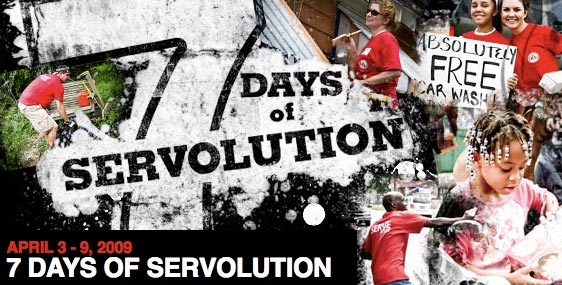
Something else we’re doing, and that YOU have an opportunity to do, is SERVOLUTION!? Dino wrote a book with the same title, which I highly recommend you order millions of copies of.? But what’s amazing is the week leading up to Easter, they are challenging churches to just get out and serve.
It’s that simple!
From the Servolution website:
7 Days of Servolution is churches from all over the world coming together to express the love of Christ to the people in their communities through simple acts of kindness and generosity. From April 3rd through the 9th we are asking you to partner with us and churches from all over the world and bring that example set by Jesus to the people in your community. As you know this is the week leading up to Easter weekend. We believe that this is a great opportunity to invite people from all over your community to come out and be a part. Many times it’s during those weekends that people are the most receptive to the Gospel message and we want to help do all that we can to fill churches everywhere for people to have an opportunity to experience the love of God through salvation.
This morning, I felt like I should pray to have an opportunity to help someone out financially.? We aren’t loaded with extra money, but we both have our jobs, can pay our bills, and have some left over at the end of the month which I know is more than a lot of people.? Within a few minutes, I checked my Facebook and there was an opportunity right there. BAM. Love it when that happens.
I know many of us in our churches pray that we will have opportunities to share grace and truth and hope with our communities.
I am thinking the biggest opportunity we’ve ever had is staring us right in the face and we don’t even realize it.
We are living in a financial crisis.? We all know our economy sucks right now.? I see a lot of emails about people losing their jobs, not being able to afford heat or food (food pantry/food stamp usage has gone up 32%).? People are living in cars.? On the street.? Wherever.
What are we doing about it?
Seth had a post today along the lines of thinking creatively in order to produce a different outcome.
Creativity changes the game, whatever game is being played. “We’re going to run out of cash by the end of the year,” is accurate unless you count creativity into the equation. Then the accurate statement is, “Under the current rules and assumptions, we’re going to run out of cash…” Big difference.
Let’s face it…churches tend to get stuck in ruts.? We do things because it’s the way either we’ve done them before or someone else has done them before.? We look for safety.? We want protection.? We want to be guaranteed success.? (Whatever that means.)
We ask for opportunities…WELL, HERE WE GO.
You want to “reach people?” What are some ways you’ve done this before? Sending out postcards? Investing in something fancy that will wow people when they arrive?? Sure…those things have merit.? They’ve “worked” before, so let’s stick with them!? That’s what we think.
RUT ALERT.
We, as the church, have a HUGE opportunity to help our communities.? What if you didn’t send out that mailer and instead, spent the thousands of dollars paying people’s heating bills or stocking up a food pantry?? What if we held off on an expensive purchase and threw a block party and got to know our neighbors?
The truth of what we communicate doesn’t change.? But how we communicate it SHOULD change, because part of how our message comes across is what we use to give that message!
We always talk about the televangelists who begged for money.? Oh, how they so desperately needed it…as they paid for premium airtime and wore fancy clothes.
That message? They don’t really need the money.
Our message is one of love.
One that puts others first.
But what are our mediums of communicating that message saying?
Does the way we do things line up with our message?
Are you willing to get out of the rut of safety and change it up?
 Jud had a book release a few weeks ago called Eyes Wide Open: See and Live the Real You. I haven’t finished it yet, but that doesn’t stop me from recommending it to you.